


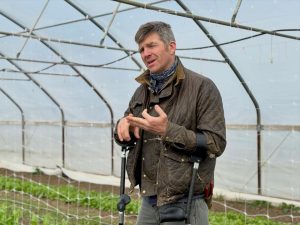
MARTELL, Neb. — At Robinette Farms, the challenge isn’t growing food. It’s getting more people to buy it.
The diversified farm and local food hub just outside Martell connects more than 30 farmers, ranchers and food producers with customers across eastern Nebraska. Through its customizable weekly subscription boxes, the operation delivers produce, meat, dairy, bread and pantry items directly to homes, restaurants and institutions.
But despite rising interest in local food, owner Alex McKiernan says demand still falls short of its potential.
“We need to get beyond the choir,” McKiernan said. “We need to expand enough and reach enough people that we can really make an impact.”
McKiernan estimates the business is reaching only a fraction of potential customers across the region, even after more than a decade in operation.
“Our guess is that we reach less than three in ten thousand households within like an hour and a half, two hours of Lincoln,” he said.
That gap highlights a broader challenge facing local food systems: changing consumer behavior.
“It starts to feel like what we need to do is change people’s behavior,” McKiernan said. “And that’s hard. It’s hard to change behavior.”
Robinette Farms was founded in 2010 with a focus on direct-to-consumer agriculture. Early on, the business operated under a community supported agriculture, or CSA, model, where customers received a pre-selected box of seasonal produce each week.
Over time, the farm shifted toward a more flexible system that allows customers to customize their orders — an adjustment driven largely by convenience.
“It seems to us that that is the biggest deciding point for most consumers is how convenient is this thing,” McKiernan said.
Today, customers can build their own weekly orders online, pulling from Robinette’s greens production as well as products from dozens of other Nebraska-based food producers.
The business itself has grown increasingly diverse. In addition to greenhouse production and food aggregation, Robinette Farms operates a grazing enterprise in southeast Nebraska, managing cattle and goats as part of a conservation-focused system.
“We have like probably too many things going on,” McKiernan said. “We grow quite a bit of local produce… then we work with a lot of other local growers… and then we have a more grassland-based, conservation-based commodity part of our business.”
That diversity reflects both opportunity and complexity in building a direct-market agricultural business.
“In the commodity markets you have very, very, very little control,” McKiernan said. “In a direct market world, there are more levers you can pull.”
Still, that control comes with added responsibility. Unlike traditional commodity producers, direct-to-consumer operators must manage not only production, but also marketing, sales and customer education.
“You have the production risk and the marketing risk and the sales risk,” he said. “And all of that is one extra job to put on top of things.”
McKiernan said the motivation to take on that challenge comes from a deeper mission.
“Food is the best way that we can connect people to land,” he said. “Healthy food is really important for everyone… and Chloe and I love being part of that.”
That philosophy extends beyond business into a broader vision for agriculture.
“I think a phrase that means a lot to me is commerce, conservation and community,” McKiernan said. “We’ve got to have businesses that are economically feasible… but if those profitable businesses come at the expense of the land or the community, they’re not sustainable.”
McKiernan’s perspective is also shaped by personal experience. In 2014, he was seriously injured in a vehicle accident that left him temporarily paralyzed and permanently changed his role on the farm.
“You have to accept the reality of your situation,” he said. “And that is a hard thing to do.”
He credits mindset as a key factor in navigating both personal and professional challenges.
“First you’ve got to get your mind right,” McKiernan said. “If you’re not focused on the challenge in front of you… those things don’t help you with right now.”
Looking ahead, McKiernan said the long-term goal is to build a business that can sustain itself — and its mission — into the future.
“Profit preserves passion,” he said. “We need to get this business to a long-term, financially sustainable place.”
Building Nebraska is presented by the Engler Agribusiness Entrepreneurship Program at the University of Nebraska–Lincoln — developing the next generation of agricultural leaders and entrepreneurs.