



LINCOLN, Neb. — One year after President Trump’s “Liberation Day” tariffs, a key member of his trade team said it’s a win for agriculture, even as other experts signal continued uncertainty.
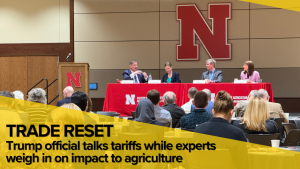
Chief Ag Negotiators Julie Callahan delivered remarks at a daylong trade symposium hosted by the Yeutter Institute at the University of Nebraska–Lincoln.
The event brought together policymakers, economists, legal scholars and agricultural leaders to examine how a rapidly shifting trade environment is reshaping global commerce and what those changes mean for U.S. farmers and ranchers.
A consistent thread throughout the day was the idea of path dependency — the notion that policy decisions made now can lock in or limit future options.
“The longer you go down a certain path, does it become harder to veer off that path later on?” said Yeutter Institute Executive Director Jill O’Donnell. “How might certain decisions that are taken now impact or constrain future policy options — even for policymakers that aren’t in office yet?”
Callahan: Reciprocal tariffs created leverage
The symposium opened with a keynote from U.S. Chief Agricultural Negotiator Julie Callahan, who joined virtually from Washington. Callahan said recent shifts in U.S. trade policy were designed to address what she described as a sustained and unsustainable agricultural trade deficit.
“Those tariff actions were intended to restore fairness in our trading relationships and to address our ballooning, unsustainable global goods trade deficit — including an out‑of‑control agricultural trade deficit,” Callahan said.
She told the audience that reciprocal tariffs imposed in 2025 fundamentally changed how trading partners engage with the United States.
“President Trump really began to communicate to countries that the U.S. market isn’t automatically open no matter how poorly they treat our companies or our farmers,” Callahan said. “That created unprecedented leverage.”
Callahan pointed to what she described as tangible progress, including nine completed reciprocal trade agreements and nine additional framework deals that are now being finalized. She said those agreements are delivering market access gains and the removal of non‑tariff barriers that have frustrated U.S. agriculture for decades.
“For agriculture negotiations, reciprocal tariffs truly have been a game changer for us,” she said. “They’ve allowed us to remove unjustified trade barriers and secure meaningful market access.”
WTO struggles add to uncertainty
Callahan also voiced sharp criticism of the World Trade Organization, saying the institution has struggled to deliver meaningful reform or enforce existing rules — particularly in agriculture.
She described recent WTO ministerial meetings as marked by inaction and conflicting demands, with many member countries seeking flexibility for themselves while resisting new obligations.
“What does it mean for the negotiating function of the WTO when a majority of members don’t believe the rules apply to them?” Callahan asked, noting that agricultural trade negotiations have remained stalled for years.
Despite those challenges, Callahan said the U.S. has not abandoned the WTO, but is increasingly pursuing bilateral and regional agreements while pressing for reform.
Courts, Congress and limits on tariff authority
Legal uncertainty was another focal point of the symposium, particularly around recent court decisions examining presidential tariff authority.
Kathleen Claussen, a Georgetown Law professor and former general counsel at the Office of the U.S. Trade Representative, said courts are clarifying constitutional limits.
“The court says the president cannot — that those words ‘regulate importation’ cannot bear the weight of what he’s got here,” Claussen said. “He can’t just put tariffs on any product at any time, for any length of time, from any country.”
She emphasized that Congress has historically guarded its authority over tariffs, and that how trade statutes are interpreted now could shape policy tools available in the future.
Markets adapt, but decisions linger
Economist Jayson Beckman, a former USDA Economic Research Service analyst, said trade policy choices often take years to reveal their full impact.
“Everything that we’ve done in the past is basically where we are now,” Beckman said. “The agreements we made — and the ones we didn’t make — influence what’s possible going forward.”
Beckman pointed to recent trade deals that include large purchase commitments but raise questions about durability.
“One deal promised Indonesia would buy 3.5 million metric tons of soybean meal for five years,” he said. “After that it drops to 300,000. That’s about a $1.5 billion difference.”
Still, Beckman said U.S. agriculture continues to hold competitive advantages, particularly in quality.
“The products we’re able to export are high quality, and countries value them,” he said.
Nebraska producers feel trade impacts firsthand
For Nebraska farmers and ranchers, trade policy debates have immediate consequences.
“As we see production capacity continue to increase, we feel that trade is one of those opportunities for reducing that pile of corn,” said Kelly Brunkhorst, executive director of the Nebraska Corn Board.
Brunkhorst highlighted Nebraska’s role in recent U.S.-Mexico-Canada Agreement disputes over white corn.
“Nebraska drove a lot of the original conversation,” he said. “We had white corn growers that were going to be severely impacted.”
He also noted that trade affects inputs as much as exports, pointing to fertilizer imports as a long‑standing concern.
“A big part of tight margins is fertilizer,” Brunkhorst said. “The imports of fertilizer we rely on around the world — that’s been an issue for a long time.”
Next generation watching closely
Students attending the symposium said trade uncertainty is part of the operating environment their generation expects to manage.
“There is so much going on in trade,” said Allison Walbrecht, an animal science major and fifth‑generation producer involved with the Yeutter Institute and Young Nebraska Cattlemen. “But we know time and time again that Nebraska producers step up to meet demand.”
Walbrecht said exposure to trade policy discussions reinforces the need for advocacy and engagement.
“Understanding policy helps us defend agriculture and our way of life,” she said.
Looking ahead
O’Donnell said the Yeutter Institute will continue using research and dialogue to track how trade policy choices ripple through agriculture and the broader economy.
“These decisions don’t just affect today,” she said. “They shape what’s possible tomorrow.”