



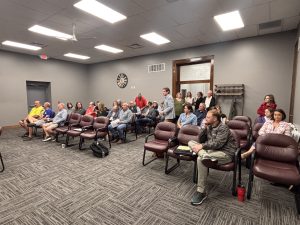
CUSTER COUNTY, Neb. — The future of the Custer County Recycling Center drew strong public response Tuesday morning, as residents, community leaders, and business owners urged the Custer County Board of Supervisors not to close a service they said remains important to small towns, local businesses, schools, and county residents.
After a lengthy discussion, the board approved a motion to keep the recycling center operating at least through the current lease period, which was discussed as running into February of 2028. While the center will remain open for now, supervisors also made clear that funding, grants, outside-community usage, and possible fee changes will need more discussion moving forward.
The recycling center has been under review as county officials look at budget pressures and the cost of operating the program. During the meeting, the discussion included the current charge for out-of-county recycling, which was said to be two cents, and whether that amount is enough to offset the labor and handling costs once material arrives in Custer County.
One supervisor said he had no issue with Custer County residents using the service because county taxpayers help support it, but said out-of-county users may need to pay more.
“I don’t have a problem in Custer County using it, because my taxes pay for it,” he said. “But I have a problem of another county using it, and we’re not charging them enough to offset our cost to do it.”
Several members of the public said the recycling center provides more than a convenience.
Mark Kimball told supervisors the center is important for communities and businesses that generate cardboard, cans, plastics, and other recyclable materials.
“The recycle center for our community is very important,” Kimball said. “We create a lot of cardboard with the number of businesses that we have in the town.”
Kimball said some communities may be willing to help shoulder costs, but they need more information and transparency before any long-term funding plan is created.
“If it is a situation where we, the communities, need to help shoulder it, we’re willing for it,” Kimball said. “But we want a lot more transparency and understanding in how it all works.”
He said closing the center without a broader discussion would not be fair to county residents.
“To just pull the plug on this… I don’t think that’s right,” Kimball said. “That’s not serving the constituents of this county justice.”
Lance Bristol of Ansley also spoke in favor of keeping the center open, saying recycling is part of the routine for residents and students in his community.
“If the recycling center closes, recycling in my town ends,” Bristol said.
He said small towns do not have the resources to haul plastics, cardboard, paper, and cans to a purchasing facility on their own. Without the county center, he said, those materials would likely go into regular trash and end up in the Lexington-area landfill.
“That’s why a county recycling center makes sense,” Bristol said. “Many small groups, in this case small communities, work together and bring the recycling to one place that can collect enough recycled materials to sell.”
Bristol also pushed back on the argument that taxpayers should not support a service they personally may not use.
“We, as taxpayers, pay for many services we don’t personally use, but we do it for the common good,” he said. “Recycling is good for our county.”
Lawrence Paulson of Callaway, who serves on the village board and owns a grocery store, said the recycling center has a direct economic impact on his community, especially when it comes to cardboard.
“Recycling here in Custer County, and this cardboard option in particular, has saved Callaway a lot of expenses on our trash truck running down to the landfill in Lexington,” Paulson said.
He said without the recycling center, costs would rise for local businesses, including his grocery store, the hardware store, the Good Life Center, and the hospital.
“Without your recycling center, all of our business expenses will go up,” Paulson said.
Paulson said Callaway is not opposed to contributing, but any plan needs to be fair. He said estimates done years ago showed the service saved the community more than $6,000 a year just in cardboard, before factoring in labor and wear and tear on equipment.
Lynette Doan of Ansley also addressed the board and said the cost of recycling should be considered at the county level because both rural and city residents use the service.
“The recycling trailer, our school uses it a lot, and it would have a definite impact on us,” Doan said. “We would be making more trips to the landfill if we could not use the recycling center.”
Doan said the cost per person for recycling in Custer County was listed at $16.64 per year, and argued that trash costs could rise for many residents if recycling is removed.
“That’s pretty cheap,” Doan said.
She also questioned whether it would be equitable to expect only cities and villages to pay more when rural residents also use the service.
“As a county, you reach everybody,” Doan said. “You guys have the authority to assess fees and taxes not just to communities, not just to cities, but to the rural residents who also use recyclables.”
Doan also said a joint meeting with communities is needed instead of one-on-one conversations.
“There’s not a gathering of the minds,” she said. “There’s not a sharing of ideas. There’s not joint discussion on financing.”
Scotty Ross, director of the Custer Economic Development Corporation, said two grant opportunities may help offset some costs, with one opening this week and another opening in July. Ross asked the board to allow more time for planning and grant research before making a permanent decision.
“At the very least, I would appreciate it if the board would offer some more time,” Ross said.
Ross also pointed to the history of the recycling center, noting that a list of goals established by the Broken Bow Industrial Corporation in 1990 included the establishment of such a facility.
“It was done,” Ross said. “I just feel like if we closed it, that would be a step backwards and just really not a progressive headline for Custer County.”
Patty Lindner of Broken Bow said she uses the local recycling trailers weekly and would hate to lose access to them.
“It amazes me how much one person can accumulate in recyclable stuff,” Lindner said. “Paper and plastic are the two big ones for me.”
She said she would rather pay a little more than see the material go to waste.
“Even if I had to pay a couple of dollars more a month, to me it’s worth it,” Lindner said.
Following public comment, recycling staff said two grants are being pursued, including one through the Nebraska Department of Environment and Energy and another believed to be through the Nebraska Environmental Trust. Staff also said meetings have taken place with BD and Casella to discuss possible efficiencies and support, though no final arrangement has been made.
A recycling representative told the board the center has kept 18,240 tons of material out of the landfill since it began in 1995.
“The goal of the recycling way back when we started was to keep material out of the landfill,” he said. “We’re doing what originally was planned.”
Supervisors also discussed whether communities should contribute more, whether out-of-county users should pay higher fees, and whether a roster of businesses using the center could help guide future funding talks.
In a separate business, the board also heard an update from representatives of the Prairie Hills Wind Farm project and approved an amendment to the project’s road agreement.
Mary Burkett, lead developer for Prairie Hills Wind with Invenergy, apologized to the county, landowners, and supervisors for a lack of communication in recent months.
“I did want to apologize for myself and for the company to the county and you all and our landowners for lack of communication over the last several months,” Burkett said.
Burkett said she was taken off the project after giving an update last September and was brought back at the end of April after another developer left the company.
“I understand your frustrations, because I’m equally frustrated,” Burkett said.
To improve communication, Burkett said Invenergy has brought on Ned Porter as land manager. She said Porter is expected to be in the area at least twice a month, often during supervisor meetings, and will work directly with landowners.
Burkett said the project remains on track for a 2028 commercial operations date, with large-scale construction planned for the middle of 2027. She said some turbine foundation work and site preparation are expected in the coming weeks to secure the county permit before a July 11 deadline.
Burkett said the company has switched to a compliant turbine and is updating related studies. She also said a shadow flicker study has been completed, while draft acoustical and decommissioning reports are expected to be provided to the county.
A major part of the discussion centered on the road use agreement, including a road impact analysis, bonding requirements, Nebraska 811 membership, and the timing of when project infrastructure and crossings must be staked.
Lee Greenwald, legal counsel for Invenergy, said the project’s construction schedule is being phased and that staking all crossings immediately would not be practical.
“That phasing makes it impractical for us to go out and stake all crossings right now,” Greenwald said.
The requested amendment allows certain access road crossings, utility crossings, and heavy crane crossing locations to be staked closer to when that specific work is scheduled, rather than before the entire project begins.
County officials raised concerns over the road impact analysis and bond. Greenwald said the road impact analysis had been provided to county representatives and included an estimated bond amount of about $3 million. County officials said they wanted the bond executed and submitted before any construction activity begins.
Greenwald said Invenergy agreed.
“We will provide the bond before any construction activity, including foundation work,” Greenwald said.
County highway officials said they were comfortable with the staking change, as long as the bonding and Nebraska 811 requirements remained in place before construction.
The board approved the Prairie Hills Wind Farm amendment to the road agreement, with one no vote recorded.
Greenwald told supervisors the company would provide more frequent updates moving forward and coordinate with county staff to make sure the road impact analysis is available to anyone who needs it.