



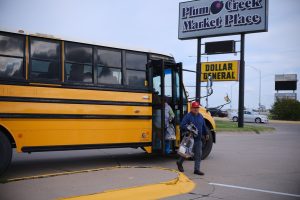
On a warm Friday in late May, Travis Harvey sat behind the wheel of a big yellow school bus in a packed parking lot. Cottonwood trees sent summer snow – tufts of white fuzz – blowing across the sky and through the open doors of the bus.
Harvey’s passengers were running a bit behind. By 5 p.m., he hadn’t seen any of his regulars exit the Sustainable Beef meatpacking plant that sits just north of Interstate 80 on the outskirts of North Platte. The sprawling facility is the newest addition to Nebraska’s meatpacking industry, employing about 800 people with a capacity to process 1,500 head of cattle daily.
The crowd arrived a little before 5:30 p.m. – first a trickle, and then a horde. They quickly filled up every seat on the bus. They carried their belongings in clear bags; speckles of blood remained on some of the workers’ arms. Even in the humid, almost 90 degree weather, most were bundled in sweaters and jackets. It’s “freezing” inside the plant, said 19-year-old Sumeya Ahmed, who just finished a 10-hour shift cutting meat.
“You got to cut the meat in a perfect size, perfect shape,” Ahmed said. “You can’t cut too much. You have to be careful with it. So your hands hurt. Your back hurts. Your eyes hurt.”
The vast majority of the workers on the bus, including Ahmed, are former employees of Tyson Foods, which shuttered a massive meatpacking plant in Lexington earlier this year and left about 3,200 people out of work in the city of just over 10,000.

The abrupt closure stunned the community, which had developed as a multicultural hub because of the job opportunities at Tyson. Dawson County’s unemployment rate ballooned from 3% in 2025 nearly 20% in April. The Federal Reserve in Kansas City has estimated that the unemployment rate could reach as high as 27% over the next three years as the aftershocks set in on the county’s economy.
Some workers moved out of Lexington to take jobs elsewhere. Tyson offered relocation assistance for employees looking to stay at the company – at least 120 transferred to the Dakota City plant, according to reporting from KLKN. Other Nebraska meatpackers, like JBS and Gibbon Packing, visited job fairs in Lexington after the closure announcement.
But most of those who left right away were young and single. It wasn’t that simple for longtime Lexington residents who had children in school, owned homes and businesses and built up a life and community in the central Nebraska city.
State-funded bus fleet keeps workers in town
Drew Price, the owner of a fleet of party buses and a rental business at nearby Johnson Lake, knew that the closure could lead to a population exodus. He immediately began thinking about how to leverage his resources to keep people in Lexington. Price knew that transportation would be a barrier, and that many of the workers would be looking for jobs in nearby cities. So he reached out to Sustainable Beef.
It took a while to work out the logistics. But in March, the first buses left Lexington for North Platte.
The service is free for the passengers. It’s paid for by a grant from the Nebraska Department of Labor, which was awarded more than $1.6 million in March from the U.S. Department of Labor’s Dislocated Worker Grant program. The grant helps pay for training for workers impacted by mass layoffs – and services, like transportation, that help them find a new job.

That funding is set to run out in September. Price has started looking at philanthropic funding as an alternative to keep the buses running.
“The first three weeks, we just kept adjusting the schedules to meet people’s wants and needs,” Price said. “Most people found out about it through word of mouth.”
As the schedules were adjusted, Price and his team of drivers found a good rhythm. Now, two buses run every day to Sustainable Beef, and another takes people to the Walmart distribution center in North Platte. The demand is so high that Price is looking to add a third daily bus to Sustainable Beef.
“It’s been successful – people aren’t moving out of town,” Price said. “I’m not sure what’s going to happen if this transportation program goes away. It’s pretty important that we get it funded and keep it going.”
The passengers have different motivations for riding. Some can’t drive, and those who can see it as an opportunity to save on gas money and avoid driving themselves home after an exhausting day of work. On the drive back to Lexington, most of the passengers closed their eyes and rested their heads against the windows or seatbacks.
Yahye Ali has no plans to leave his city. After living in Lexington for almost 22 years, Ali won’t entertain the idea of living anywhere else. He doesn’t mind working in North Platte, but he doesn’t want to move there.
“Even if I got fired in here, I would look for another job inside of Lexington,” Ali said. “I want to go nowhere else outside of Lexington. I’m an African immigrant, but I’m an American citizen. I’m a real Nebraskan. I love Nebraska – and I’m dying here. They’re gonna make a grave in here.”

Others, like Alejandro Ordez, see the bus as a temporary fix. Ordez lived in Lexington and worked at Tyson for 17 years before the closure. He’s considering moving to North Platte.
“It is getting more empty in Lexington,” Ordez said. “If I stay [at Sustainable Beef], it’s best I move here.”
Local businesses feel population shift
On the city’s main street, the worker exodus is evident. A few businesses have signs advising of reduced hours. Posters advertising homes for rent and for sale adorn the windows of businesses. It even smells different without the plant running.
Enrique Pellecer, 77, wasn’t planning on retiring, but he decided to do so after the shutdown. He moved to Lexington in 2000 and had worked overnights at the Tyson plant since 2008. Now, in lieu of a job, he ambles through downtown to talk to the shop owners who remain.
“This small town looks so sad,” Pellecer said. “Because so many businesses have closed, other owners are left all alone. You can tell from the street’s look. Back then, I would go outside with my friends to sit and talk.”

Pellecer is comfortable staying in Lexington. He’s seen many people move – to Grand Island, or to Iowa or South Dakota. Companies came “from everywhere” to pick up the laid-off workers and conducted interviews at the city library. He decided to stick around.
“In my case, I don’t have many problems,” Pellecer said. “I’m retired.”
A few blocks from where Pellecer is visiting friends’ shops, Sara Ramirez tends to the lunch buffet at La Hacienda, a Mexican restaurant she owns with her husband, Javier.
Back in December, as the city was still absorbing the scale of the loss, Javier said he was waiting to see how the closure would impact their business. Friends moved, and sales went down. Earlier this year, Javier returned to Mexico to care for his brother, who has down syndrome.
“When [Javier] is here, we pay for a caretaker – someone to care for his brother and feed him,” Sara said. “Since business has gone down, [Javier] went to take care of him.”
The couple moved to Lexington in 1992 and began working at the meatpacking plant, which was then owned by Iowa Beef Packers and later bought by Tyson. They bought a restaurant that had come up for sale, and they learned how to run it as a family. Sara and Javier watched as the population grew and a sense of community took hold.

“Everything was busier on Thursdays. That’s when Tyson paid its employees,” Sara said. “Those who worked the afternoon shift would come to eat and then go back to work. Or those leaving Tyson would come to eat and place orders. There was a lot more activity. You could see that when we first arrived – there were few houses, few buildings. Then they started building apartments, more new houses, and the community was growing. There was a lot – a lot. We were comfortable. It was very beautiful.”
Sara and Javier own the building that the restaurant occupies. Their children are grown, and some have already moved out of Lexington. Over a FaceTime call, Javier said they will “hold on for a little bit more” and see if a different company can make something of the now-vacant plant. Pellecer, too, holds out some hope that Tyson will re-open or something else will open up in its place.
As of June, though, there has been no news about a new tenant for the plant or a redevelopment opportunity. The City of Lexington announced in April that it would acquire Tyson’s wastewater treatment plant and nearby farmland, and partner with Tyson on “strategic initiatives aimed at attracting private investment” and “fostering job creation.”
The lack of movement has left people feeling “defeated,” Sara said.
“We all depended on the Tyson company,” she said.” Now many have moved away, the kids have to be taken out of school. And we have to look for a future. Because here there isn’t.”