


More than 100 college students from across the Midwest gathered in Gothenburg this week to put their weed science knowledge to the test in a competition designed to mirror the real-world challenges they’ll face in agriculture careers.
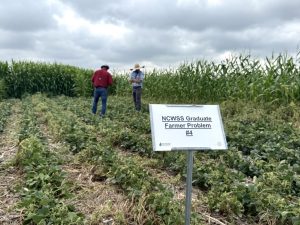
The North Central Weed Science Society Student Weed Contest, hosted at Bayer’s Water Utilization Learning Center, brought together undergraduate and graduate students to compete in weed identification, herbicide injury diagnosis, sprayer calibration, mathematical calculations and simulated “farmer problems” that require participants to diagnose field issues and recommend solutions.
For Ankit Yadav, a doctoral student in weed science at the University of Nebraska-Lincoln, the contest provides practical experience that extends far beyond the classroom.
“This competition is so unique,” Yadav said. “These are all skills you need when you’re working as an agronomy representative or in academia. You’ll be facing these real-life challenges from farmers.”
Yadav hopes to become an extension weed management specialist or professor at a land-grant university and said the farmer problem scenarios are especially valuable because they replicate the questions extension specialists receive from producers every day.
UNL students spend months preparing for the annual contest through a dedicated course that includes weed identification, sprayer calibration, herbicide symptomology and mock farmer scenarios.
“We prepare as a team for six straight months,” Yadav said. “It’s worth the time and worth the effort.”
Students from other universities echoed the competition’s practical value.
Roam Hoskin, an agronomy student at Kansas State University, said nearly every contest category reflects skills graduates will use in industry.
“It’s all stuff that we would use out in the real world once we’re out of school working in industry,” Hoskin said. “It’s just very practical.”
Hoskin also said the event highlights the growing need for weed science professionals.
“There’s just not a lot of people that want to go into it,” he said. “Companies use this as a recruiting event, and that’s a big takeaway for us.”
The contest is supported by universities and agricultural companies alike, reflecting the industry’s demand for graduates with strong technical and problem-solving abilities.
Roger Farr, a field agronomist with Bayer Crop Science and one of the event’s organizers, said the contest is designed to prepare students for the challenges they’ll encounter while working with farmers.
“The students are testing their knowledge across a wide array of the discipline that we call weed science,” Farr said. “They’re learning to identify issues, solve problems and communicate recommendations.”
Many of the contest’s farmer problem scenarios are based on actual situations Farr has encountered throughout his career as an agronomist.
Planning the event took roughly two years and involved over 70 volunteers. Farr said organizers carefully developed contest scenarios to strike the right balance between challenging and achievable while coordinating logistics ranging from field stations to transportation.
The contest rotates among host locations across the region, last held in Nebraska in 2018. Farr said bringing it back to Nebraska was an opportunity to showcase the state’s leadership in agricultural education.
Ultimately, he believes the event succeeds because it gives students something difficult to replicate in a classroom setting: real-world experience.
“I truly credit the contest itself for making me able to do what I can on a day-to-day basis,” Farr said. “It’s one of the best educational opportunities students can have because they’re solving real-world problems they’ll face in their careers.”