



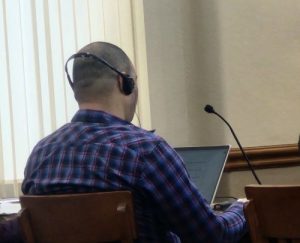
The State continued it’s case before a Dawson County District Court Jury Thursday in the 1st Degree Murder Trial of 35-year-old Aristh Rodriguez-Linares who is accused in the shooting death of 40-year-old Maykel Farinas-Carballo on January 21, 2025. Law enforcement has testified that the shooting happened outside of Rodriguez-Linares’ home as Farinas-Carballo was sitting in the driver’s seat of his car.
Assistant Attorney General Sandra Allen began the day by calling Rodriguez-Linares’ mother and stepfather to the stand. Both lived with him at the time. They testified they were at work when the shooting happened and only learned about it after coming home around 12:30am on January 22, 2025. Rodriguez-Linares’ stepfather testified that Rodriguez-Linares sent him a text message earlier indicating that he had shot Farinas-Carballo but, did not see the message until he got to the scene.
His mother said Farinas-Carballo told her and Rodriguez-Linares at their house that he “records all conversations” and felt threatened by him. She said Farinas-Carballo asked if he could move into their home and she told him she did not want him there.
A second exam of Monte Carlo conducted more than a year later
Nebraska State Patrol Special Investigations Team Sgt. Dion Neumiller testified about a shooting reconstruction conducted on the Chevrolet Monte Carlo involved in the fatal shooting investigation. Neumiller, who has been involved in 18 shooting investigations since the team’s creation in 2021, told jurors the primary goal of a shooting reconstruction is to determine where shots originated and, when possible, identify the path and sequence of bullets.
Neumiller said he examined the Monte Carlo in May 2026 at a secured impound lot in Dawson County. Using photographs, trajectory rods and laser scanning technology, he documented bullet defects in the windshield, doors and other parts of the vehicle. He also reviewed police reports, Faro scan data collected the night of the shooting, and the autopsy report of Farinas-Carballo. During the examination, he identified an additional bullet defect that had not been previously documented.
The investigator testified that software analysis allowed him to extend the trajectories of several bullets and estimate their horizontal points of origin. He said the reconstruction showed the shots came from the front-right side of the Monte Carlo, although he could not determine the exact distance of the shooter because bullets passing through laminated windshield glass can be deflected. He also told jurors the trajectories he calculated were consistent with findings from the autopsy.
Under questioning from both prosecutors and defense attorneys, Neumiller acknowledged limitations caused by the passage of time before his examination, including changes to the vehicle and damage to the glass. However, he said he remained confident in his conclusion that the shooter was positioned somewhere between the front door of the residence and the front-right corner of the Monte Carlo when the shots were fired. Defense attorneys challenged the precision of that conclusion, while Neumiller maintained the available evidence supported the estimated location of the shooter.
Crime Lab Expert Links Glock to Shell Casings in Lexington Homicide Trial
A Nebraska State Patrol firearms examiner testified Wednesday that shell casings recovered in a Lexington homicide investigation were fired from a Glock 17 handgun submitted as evidence in the case. Amy Weber, a firearms and tool mark analyst with the Nebraska State Patrol Crime Laboratory, told jurors she has worked in the field for 18 years and conducted extensive testing on a Glock 17 9mm pistol, its magazine, spent shell casings, and bullet fragments recovered during the investigation.
Weber explained that firearms examiners compare microscopic markings left on cartridge cases and bullets during the firing process. After test-firing the Glock and comparing those known samples to evidence collected from the scene, Weber concluded that cartridge cases labeled as items 3 through 13 were fired from the Glock 17 submitted to the lab. The conclusion was based on matching firing pin impressions, breech face markings, firing pin drag marks and other unique characteristics left by the weapon.
However, Weber said the investigation produced different results when it came to bullet fragments recovered from the victim and the scene. While several of the fragments shared characteristics consistent with 9mm Blazer CCI ammunition, many were heavily damaged, making a definitive comparison impossible. Weber testified she could neither identify nor eliminate the Glock as the source of several bullet fragments because of missing jacket material, distortion, and poor-quality markings.
Under questioning, Weber told jurors that bullet comparisons can become especially difficult when projectiles pass through objects such as vehicle windshields. She said damage caused by glass and the Glock’s polygonal rifling system often limits the amount of microscopic detail available for analysis. Despite those limitations, Weber testified she was confident in her conclusion that the recovered cartridge cases had been fired from the Glock 17 presented as evidence in the case.
Camera footage provides some audio evidence
James White, Jr was the last witness called to the stand Thursday. White is property manager of the Willow Ridgte trailer home community where the shooting happened.
White testified that only one of the property’s cameras recorded audio and that it was positioned toward the office door. Two additional cameras captured video in other directions, including an area near Cypress Lane.
White said he and two employees reviewed footage the next day. He testified that one video showed motion and what appeared to be a vehicle entering the area, traveling down Cypress Lane, and parking near lots in the 75 and 76 range. However, he said the footage was not clear enough for him to identify the exact location where the vehicle stopped.
However audio from another video recorded 11 gunshots on the evening of the shooting and that audio was played in the Court. The witness was then excused from the stand.
The trial continues today at the Dawson County Courthouse in Lexington.