



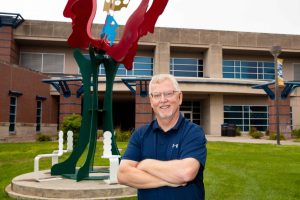
KEARNEY, Neb. — Long before Mike Teahon became a superintendent, university professor and statewide leader in education, he was a quiet farm kid growing up between Arnold and Anselmo.
The lessons he learned there — work hard, treat people well and serve the community — became the foundation of a career that has spanned more than four decades.
That career was recognized last month when the Nebraska Council of School Administrators presented Teahon with its Distinguished Service Award during Administrators’ Days at the Younes Conference Center in Kearney.
“It was really nice to be recognized by my peers and colleagues from across the state,” Teahon said. “I have a lot of good friends in the education industry, and it’s honestly very humbling to be recognized in this way.”
The annual award honors individuals who have demonstrated exceptional leadership and service to public education. Teahon, an associate professor and chair of the University of Nebraska at Kearney’s Department of Educational Administration, used his acceptance speech to recognize the administrators gathered in the room.
“Education is a service industry,” he said. “Our role and mission in life is to give back to others and serve the communities and families in which we live. It’s kind of a difficult job sometimes, but what a great opportunity to serve kids and families.”
Teahon’s commitment to education can be traced back to his upbringing on a small farm and ranch about 16 miles from school.
“It was kind of out there in the middle of nowhere, but you learn a great work ethic and the importance of treating people well and working with your neighbors,” he said.
Fall sports brought especially long days. Teahon remembers changing irrigation pipes before attending 7 a.m. football practice, then returning home in the afternoon to load hay bales.
“If you didn’t get the work done, no one else was going to do it for you,” he said. “There was just an expectation growing up on a farm and in an agricultural community that we did that. It was a great way to learn about responsibility and accountability.”
Although the days were long, Teahon said those experiences helped shape the person and educator he became.
Arnold also gave him opportunities to grow outside the classroom. He participated in football, basketball, track, golf, one-act play and speech — experiences that helped a naturally shy student develop confidence and communication skills.
“When I was really young, I was really shy,” Teahon said. “Coming out from the farm and living in the country, I didn’t spend a lot of time in town. But I had some great teachers who helped change that and helped me grow.”
Speech was particularly influential. Teachers and directors encouraged Teahon to step outside his comfort zone, helping him develop skills that would later become essential to his career.
“Building relationships and being able to communicate with people is a really important thing,” he said. “Those are a lot of the skills and values that I learned at Arnold Public Schools.”
Teahon remembers Arnold as a close-knit and progressive community where residents supported local events and the school served as a central gathering place. He continues to follow activities in the community, including its annual summer road race.
“In small towns and small schools, you need everybody involved and engaged to be successful,” he said. “It’s a great commitment and effort, with everybody joining in and assisting.”
Teahon did not initially plan to become an educator. A first-generation college student, he was the first member of his family to attend a four-year school. He was also accepted into law school and considered other career opportunities, but his interest in teaching and coaching continued to pull him toward education.
He earned a bachelor’s degree in secondary education from Kearney State College in 1985 and began his career as a math and history teacher and coach. He later served as a secondary principal before spending 20 years as a superintendent, including his final 18 years in K-12 education at Gothenburg Public Schools.
Teahon and his wife carefully considered where they wanted to raise their family, creating a list of Nebraska communities and schools they viewed as good fits. Gothenburg ranked first.
“All four of our children graduated from Gothenburg High School,” he said. “To this day, I still drive back up there from Kearney and announce their football games and track meets. I still have great connections within that community and the school.”
Throughout his career, Teahon maintained close ties to UNK. He earned a master’s degree in educational administration from the university in 1994 and an education specialist degree in 1999. He began teaching as an adjunct faculty member in 2013, became chair of the Department of Educational Administration in 2018 and joined the faculty full time the following year.
Teahon now teaches courses in school business management, supervision of instruction, school law and public school finance while also overseeing internships. His students represent districts ranging from Harrison to Millard.
He views his current role as an opportunity to provide the same type of guidance he received from mentors throughout his career.
“I believe we’re all placed on this earth for a reason,” Teahon said. “I think one of mine is to help guide and mentor others in a way that mentorship was provided for me.”
His background as a math teacher and superintendent makes school finance one of his primary areas of focus. Teahon teaches future administrators to balance providing strong opportunities for students with being responsible stewards of taxpayer dollars, especially in rural communities.
“We deal with people’s two most important assets — their kids and their money,” he said. “That’s an incredible responsibility and one that educators take with great pride.”
Teahon also encourages aspiring administrators to consider serving rural districts, where school leaders often become deeply involved in the broader community.
“You can really become a part of those smaller communities,” he said. “What a great place to raise a family.”
For young people considering teaching, Teahon points to the lasting impact educators can make. Some of his most rewarding moments occur when former students recognize him and share what they have accomplished since leaving his classroom.
“There’s no better day in the school year than that first day of school when everybody’s excited,” he said. “But it’s equally cool when those kids walk across the stage, go out into the world and have a great life.”
From the farm near Arnold to the classrooms of UNK, Teahon said the Distinguished Service Award represents a humbling, full-circle moment.
“I like people, I like helping people and I like supporting and helping grow the next generation,” he said. “Educators serve families and communities, and that’s incredibly important for our state, our country and our world.”