



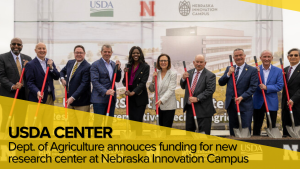
LINCOLN, Neb. — The U.S. Department of Agriculture plans to direct 37 million dollars toward construction of a new Agricultural Research Service facility at the University of Nebraska-Lincoln’s Nebraska Innovation Campus, a move Sen. Deb Fischer says will help bring the project closer to completion.
The money is part of a larger USDA reprogramming of funds that had been designated for modernization at the Beltsville Agricultural Research Center in Maryland. USDA says it is decommissioning Beltsville and moving funded research programs to other ARS locations as part of a broader reorganization of its Research, Education and Economics mission area.
The Lincoln funding is intended to fully fund construction of the new ARS National Center for Resilient and Regenerative Precision Agriculture. The center, located at Nebraska Innovation Campus, is designed as a federal research hub for agricultural innovation, including precision agriculture, crop production, water and climate resilience, and regenerative production systems.
Fischer, R-Neb., said the announcement is “great news for UNL and the future of the ARS facility.” She said she has worked over several years to secure more than 70 million dollars in federal investments for the project, including funding in fiscal years 2021, 2022, 2024 and 2026.
According to USDA, the broader reprogramming totals $75.7 million. In addition to the $37 million for Lincoln, USDA plans to send $26.7 million to fully fund a new laboratory at the ARS Forage-Animal Production Research Unit in Lexington, Kentucky, and $12 million to design a new National Plant Germplasm System Centralized Distribution Center in Ames, Iowa.
The Lincoln project has been years in the making. Construction began in 2024 on the National Center for Resilient and Regenerative Precision Agriculture, a partnership among USDA’s Agricultural Research Service, UNL and Nebraska Innovation Campus. The facility is expected to support ARS research on crops including wheat, barley, sorghum, forage and bioenergy grasses, along with work aimed at helping producers respond to emerging pests, pathogens and environmental stress.
That same restructuring also gives Nebraska another boost. In April, Fischer welcomed USDA’s plan to move one research project and 10 employees to the U.S. Meat Animal Research Center in Clay Center.
Fischer said in April that adding research to USMARC would benefit Nebraska farmers and ranchers by placing federal research closer to the field. With the new Lincoln funding, Nebraska’s role in USDA agriculture research would expand on both crop and livestock fronts: a precision agriculture center in Lincoln as the lead project, and added research capacity at the long-standing U.S. Meat Animal Research Center.