



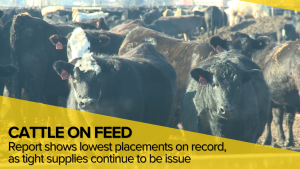
Cattle inventories in U.S. feedlots rose 2% from a year ago, but sharply lower placements and marketings point to continued tightening in the cattle supply.
The USDA’s August Cattle on Feed report shows 11.1 million head of cattle and calves on feed August 1 in feedlots with capacity of 1,000 head or more.
Placements during July totaled 1.42 million head, down 11% from a year ago and the lowest July placement total since the USDA began tracking the series in 1996.
Livestock analyst Kyle Bumsted says the placement number was significantly lower than the trade expected.
“That placement number is kind of going to be a headline here in the trade,” Bumsted says. “We really braced for down 7% and they got down 11%.”
The decline was broad across weight classes. July placements included 310,000 head weighing less than 600 pounds, compared with 340,000 a year ago. Placements of cattle weighing 600 to 699 pounds totaled 535,000 head, while cattle weighing 800 pounds and heavier totaled 577,000 head, according to Bumsted’s analysis of the report.
“Even the light end thinned out, and the cattle just aren’t out there,” Bumsted says.
At the same time, feedlots are holding onto cattle longer. July marketings totaled 1.62 million head, down 7% from a year ago and also the lowest July total since the series began in 1996.
“Feed yards are still holding on to more cattle than we did a year ago,” Bumsted says. “The cattle just aren’t leaving.”
He points to slower slaughter rates and heavier carcass weights as factors helping explain the numbers. Bumsted says carcasses remain about 50 pounds above the 10-year average.
“Just because we’ve got tight cattle doesn’t mean we’ve got tight beef,” he says. “The scales are making up for the head count here to some extent.”
The combination of fewer cattle entering feedlots and slower movement out the back door is creating a tighter supply picture ahead.
“Record low placement number means the supply behind that wall just got a little bit thinner,” Bumsted says. “And the calf crop’s the smallest on record.”
Nebraska had 2.47 million cattle on feed August 1, up 3% from a year ago, while placements were down 14%. Texas had 2.51 million head on feed, up 1%, with placements even with a year ago.
Bumsted says the reopening of the U.S.-Mexico border to cattle imports at Douglas, Arizona, will also be something the market watches closely. He expects those cattle numbers to show up in USDA data later in the fall, although traders are likely to factor the development into the market sooner.
“The cattle get scarce, so the only argument is when is this market going to open up and see it,” Bumsted says. “Or maybe we’ve already digested it here, given what we’ve seen.”