



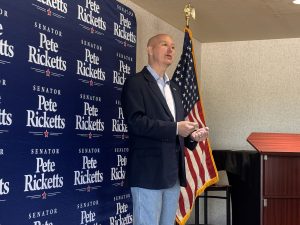
BROKEN BOW, Neb. — U.S. Sen. Pete Ricketts urged rural Nebraska communities to negotiate aggressively with data center developers while discussing agriculture, housing and infrastructure during a campaign stop Monday in Broken Bow.
Ricketts said communities considering a data center should establish protections for local water supplies and electric rates before approving a project. He said local leaders should also pursue broader financial benefits, including property tax relief and investments in roads or schools.
“Communities are in the driver’s seat,” Ricketts said. “They should decide, before they allow the data center to come in, what they want to be able to get from that data center.”
Ricketts encouraged communities to compare proposals and consult with state officials and other areas that have negotiated data center agreements. He pointed to projects elsewhere in the country that he said have provided property tax assistance and bonuses for local teachers.
The senator said data centers are also important to the country’s artificial intelligence development and competition with China. However, he maintained that conserving water and preventing increases in residents’ utility rates should be basic requirements for any development.
Broken Bow City Administrator David Schmidt asked Ricketts about assistance available to small communities facing rising infrastructure costs. Schmidt cited the February 2024 explosion and fire at Broken Bow’s power plant and the cost of restoring local generating capacity.
Ricketts said federal permitting reform could reduce the time and expense involved in infrastructure projects. He also encouraged the city to contact his office to explore potential grant programs.
Demand for electrical equipment remains another obstacle, Ricketts said, noting that utilities can face yearslong waits for generating equipment. He also called for reviewing federal regulations that increase the cost of equipment such as transformers.
Agriculture was another major focus of the visit. Ricketts criticized proposals to increase foreign beef imports as a short-term response to high grocery prices, arguing that the policy would provide little benefit to consumers while hurting American cattle producers.
The longer-term answer, he said, is rebuilding a national cattle herd that has fallen to levels not seen since the 1950s. Ricketts said opening more federal land to grazing and controlling New World screwworm could give ranchers greater confidence and access to cattle needed to expand their herds.
“There’s not an easy short-term fix for this,” Ricketts said. “Allowing low-quality foreign beef to come in is not the answer.”
Ricketts also said he is co-sponsoring legislation seeking mandatory country-of-origin labeling for beef, although any proposal would need to comply with World Trade Organization rules.
Expanding international trade and supporting renewable fuels are additional ways the federal government can assist Nebraska producers, Ricketts said in an interview with KBEAR.
He said federal trade promotion funding was doubled under tax legislation approved last year and cited expanded agricultural access in markets including the United Kingdom. Ricketts said opening more overseas markets would allow Nebraska farmers and ranchers to sell more products.
On renewable fuels, Ricketts said year-round nationwide sales of E15 are included in the pending farm bill. The legislation remains stalled amid disagreements over proposed changes to federal food assistance programs.
Ricketts said lawmakers must also protect the Renewable Fuel Standard and prevent excessive small-refinery exemptions from reducing demand for ethanol.
“Renewable fuels are good for consumers,” Ricketts said. “They save money at the pump, help clean up the environment, and they’re great for our farmers and ranchers.”
Housing affordability was also discussed. Ricketts said changes included in federal housing legislation could remove regulatory barriers and reduce the price of manufactured homes by about $10,000. He also highlighted rural workforce housing programs that allow communities to partner with developers through low-interest or bridge loans.
Ricketts said controlling federal spending does not necessarily require eliminating services used by rural residents. He said the federal government should instead use improved technology and more efficient processes to control costs while continuing to provide essential programs.
The campaign event included remarks from Nebraska State Sen. Tanya Storer and focused heavily on Ricketts’ race against independent candidate Dan Osborn. Ricketts criticized Osborn’s policies, donors and ties to Democratic organizations while asking supporters to encourage voter participation ahead of the Nov. 3 election.
The candidates are scheduled to debate Sept. 1 at the Nebraska State Fair.