


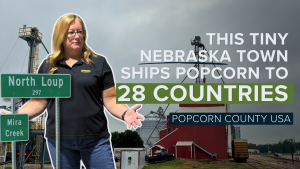
When you set your eyes on a seemingly small white house with a front porch, marked only by a humble sign just off Highway 11, you might wonder if you’re in the right place. You’ll question yourself even more when you open the door to find just a few employees.
But nestled in the town of fewer than 300 people is a popcorn operation with a reach that extends far beyond the fields of central Nebraska, shipping its kernels to all 50 states and nearly 30 countries around the world.
It’s an unlikely setting for a global popcorn business, but North Loup has been at the center of Nebraska’s popcorn industry for generations.
Popcorn is a specialty corn crop with a long history in Nebraska. The state produces roughly one-third of the nation’s popcorn supply, according to the Nebraska Department of Agriculture, with irrigation, fertile soils and the state’s agricultural infrastructure helping support production. It goes back and forth with Indiana as the number one popcorn producing state.
In North Loup, that specialty crop has become a major part of the local agricultural economy.
POPCORN COUNTY USA REACHES 28 COUNTRIES
Popcorn County USA has been processing popcorn in the community since 1979. The company works with contracted growers, including several in the North Loup area, who raise specific popcorn hybrids for the business.
Mandy Goodrich, the company’s office and human resources manager, said the North Loup Valley has a particularly long history with the crop.
“Basically, our ground is so fertile because of the North Loup River that goes by us,” Goodrich said. “Valley County has been a high producer of popcorn for many, many years.”
That history, she estimates at 100 years, is part of a larger Nebraska advantage. Popcorn production is similar to field corn production, and the plants can actually be difficult to distinguish once they’re growing. Nebraska Extension says the state’s rise as a major popcorn producer beginning in the 1970s was driven in part by irrigation, which provides more consistent yields. That’s an important factor when popcorn is grown under contract.
But there are differences in how the crop is managed.
Popcorn cannot simply follow field corn in a rotation, Goodrich said. Growers need to include a break in the rotation, such as soybeans, before planting popcorn again.
“All popcorn is non-GMO,” Goodrich said. “And so that’s kind of beneficial. We don’t put anything on it that is harmful. The only thing different is in the rotation. You can’t follow field corn in the field. It has to either have a break or soybeans or something like that.”
The crop also comes in different varieties, each suited to different markets.
Yellow popcorn produces the large, fluffy kernels familiar from movie theaters. Mushroom popcorn forms a rounder kernel that is commonly used for caramel corn, while white popcorn produces a smaller kernel with a softer hull.
Once harvested, the popcorn grown for Popcorn County USA comes into the North Loup facility much like a conventional grain crop.
Growers bring it in from the field, where it is placed in bins and conditioned for several months. From there, the company processes and packages the kernels for customers ranging from movie theaters and popcorn shops to distributors and schools.
The company’s reach extends well beyond Nebraska. Goodrich said Popcorn County USA ships throughout the United States and to about 28 countries, including Mexico, Canada, Ireland, Italy, the Philippines and Vietnam.
POPCORN COUNTY GETS A MAJOR EXPANSION
The business is now expanding its own ability to handle that immense demand.
A new processing facility in North Loup is expected to more than double the company’s storage capacity and increase production with automated equipment. The operation currently bags its popcorn by hand, but the new facility will automate much of that process.
“Nothing will really be handmade anymore,” Goodrich said. “Right now we hand bag everything. Kind of a special touch, and now it will all be automated. And we’re looking forward to so much more storage and the increase in production. It’ll be awesome.”
The additional capacity could also change how quickly the company can respond to orders. Instead of processing each order as it comes in, the company will have more space to prepare and store packaged product.
Goodrich said that could reduce production time from about two weeks to a day or two.
For a Nebraska community with roughly 250 people, the processing operation creates a connection between local growers and consumers far beyond the North Loup Valley.