



Fridays in the Field is presented by FNBO – The Great Big, Small Bank.
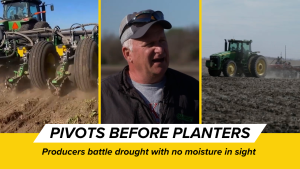
As planters begin to roll across the Cornhusker State, Nebraska farmers are staring down some of the driest conditions in years, forcing many to fire up irrigation pivots before the first seed even hits the soil.
Data from the U.S. Drought Monitor released April 14, 2026, shows the severity of the situation. Over 80% of the state is currently locked in “Severe Drought” (D2) or worse, a massive jump from just 10% three months ago. For producers in the southwest and Panhandle, the situation is even more dire, with nearly 44% of the state now classified under “Extreme Drought” (D3).
Running Pivots Ahead of Planters
For many, the traditional order of spring operations has been flipped. In Holdrege, Blake Johnson says the bone-dry topsoil has made seedbed preparation a logistical puzzle.
“The conditions are challenging,” Johnson said. “We’ve had to get a lot of center pivots ready and run them around to incorporate some herbicide and run them ahead of our corn planters… it looks like it’s going to be a rather challenging planting season to manage the pivots ahead of the planters.”
Further west in Alliance, Doug Hashman reports that even the resilient winter wheat crop is starting to flag. While stands initially looked “better than they should,” the relentless Nebraska wind is taking its toll.
“There is a little bit of brown spots showing up that are just flat running out of water,” Hashman said. “I visited with a 100-year-old neighbor that said he’s never seen a winter like this… never seen this kind of weather be as open as it is.”
Regional Divide: Pockets of Hope vs. Total Shutoff
The moisture situation varies by zip code. In Randolph, Lucas Miller, President of the Nebraska Soybean Association, caught a rare break with one to two inches of rain recently. While he remains wary of the subsoil deficit, the immediate outlook is slightly more optimistic for his area.
“Moisture-wise, we’re still behind,” Miller said. “But an inch to two inches of rain really, really helped out… got us some good moisture in the seed zone right now.”
That optimism is harder to find in Trenton, where Mike Baker says the taps turned off months ago.
“We had a really good last fall… and then about mid-November it shut off and we have had no measurable precipitation since then,” Baker said. “The top three or four inches are super dry and we need some help.”
Economic Headwinds
Beyond the weather, farmers are grappling with a volatile global market. While grain sorghum has seen a “bump” thanks to Chinese buying interest, Baker said skyrocketing input costs are eating into potential profits.
In Waverly, Dave Nielsen says he’s skipping phosphorus applications this year because prices are simply too high. “We’re going to mine a little bit of ours,” Nielsen said, relying on existing soil levels and biosolids.
Despite the lack of rain and global tension, the “eternal optimism” of the American farmer remains the primary fuel for the season.
In Eustis, Anthony Gengebach is still waiting for a sign from the skies before fully committing to the field.
“The top five inches of the ground are pretty hard right now,” Gengebach said. “It’s been a struggle to get through some of that… we’re kind of hoping for a rain before we get started.”