



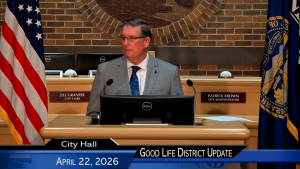
Negotiations to create a Good Life District in Grand Island have reached an impasse, the city’s mayor said Wednesday.
Mayor Roger Steele accused the developer of proposing terms he called unacceptable under state law.
At a news conference, Steele said talks with Woodsonia stalled after the company’s most recent proposal sought to acquire roughly 150 acres of city‑owned land for a dollar.
“An offer of $1 for the city’s land is ridiculous,” Steele said.
Good Life Districts allow redevelopment areas to capture a portion of state sales tax revenue to fund infrastructure and other public improvements. Nebraska lawmakers have authorized only a small number of such districts statewide.
Woodsonia acquired the former Conestoga Mall and has already overseen development that includes a Target store and an outdoor retail center with tenants such as Old Navy and Chick‑fil‑A. The next phase involves land near the former Grand Island Veterans Home, envisioned as a mixed‑use project including housing, retail, a sports complex and an aquatic center.
Steele said Woodsonia initially requested that the city donate the land, an idea he said the city rejected because state law requires municipalities to receive fair market value for public property. He said those requests continued, sometimes framed as proposals for the city to provide the funds Woodsonia would use to purchase the land.
After months of negotiations, Steele said he asked in the fall for Woodsonia’s “best and final offer,” but accused the firm of later retreating from its own proposal. In early March, he said, Woodsonia submitted another “best and final” offer — again proposing to buy the land for $1.
City officials halted negotiations in March, Steele said, after Woodsonia’s attorney acknowledged an impasse. City staff then informed the developer they were moving forward independently with requests for proposals related to city‑owned projects within the district.
Under the city’s current plan, Grand Island would proceed with infrastructure work and construction of public facilities including the sports complex and aquatic center, projects Steele emphasized would be city‑owned.
“The Good Life District is about building,” Steele said. “It means moving dirt and constructing.”
Woodsonia later replaced its dollar offer with a new proposal dated April 5, offering $10,000 per acre. While Steele called that a “serious offer,” he said the proposal also included provisions he believes could jeopardize the entire development.
Steele said those provisions would allow Woodsonia to terminate agreements while retaining the land and up to $10 million in payments, or cancel the project based on conditions it alone deemed unacceptable, without requiring any construction.
“That is not acceptable,” Steele said, warning that such terms could leave the city without development, public amenities or recourse. He also highlighted Kearney is moving quickly on its Good Life project, expressing frustration.
“Our negotiations are making us lag behind with talking when we should be building,” Steele said.
Former Mayor Jay Vavricek spoke up during the press conference.
“It reminds me of when we had the state fair relocate here. There were a lot of sticky things that needed to go through there. But when there was a willingness to get it done, all the entities came together,” Vavricek said, ask he asked for clarity on where the project stands.
The City Council is scheduled to discuss Woodsonia’s latest proposal at its May 12 meeting.
Steele also cited complications with Good Life District tax revenue, which is now collected by the state rather than the city. He said collections have dropped and become inconsistent, limiting the city’s bonding capacity and its ability to meet some funding requests from Woodsonia.
During a question‑and‑answer session, Mitch Hohlen of Woodsonia disputed the mayor’s characterization of the process, saying the developer has consistently pushed for transparency and community involvement.
“We feel like it has not been a transparent process,” Hohlen said, urging the city to commit to open negotiations and public review of submitted development documents.
Steele said his preference is for future negotiations to occur during open City Council meetings, though he would not rule out executive sessions for matters such as property acquisition that he said are legally sensitive.
Steele was asked about plans for an aquatic center and sports complex, and Woodsonia’s future involvement.
“I don’t want to leave you with the impression that we have slammed the door on Woodsonia. That is not the case,” he said.
He had been pushing for work to begin this year, but now said that is unlikely. Steele said he does not want everything decided in one night but said the magnitude of the project will require a sequence of decisions.
“This is a 30‑year project,” Steele said. “We need to take the steps incrementally to make sure we’re getting it right.”