



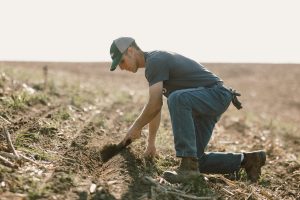
This week marks Earth Day, which coincides with Nebraska farmers getting in the field where they say conservation practices help them farm down to the inch.
More than 95 percent of Nebraska is now classified as abnormally dry or worse, according to the latest U.S. Drought Monitor, with over half the state in severe to extreme drought. That lack of moisture has renewed attention on soil health and water conservation, particularly following recent wildfires that have scorched rangeland and pasture.
Boone County corn producer John Krohn said dry conditions are already shaping decisions in the field this spring. Krohn, a fifth‑generation farmer who also serves on the Nebraska Corn Board, said conservation practices such as no‑till and cover crops play a critical role during dry years.
“A big part of no‑till is to conserve every single raindrop,” Krohn said. “Every time you run a piece of machinery across the dirt or whatever, you lose some of that water, it dries the soil back out.”
He said his operation has used cereal rye cover crops for about a decade, particularly following soybeans, to reduce erosion and improve soil structure. Krohn said those practices help rainfall infiltrate the soil instead of running off, preserving moisture for crops later in the season.
“Cereal rye is definitely a big part of my operation,” he said. Krohn has been honored by Nebraska’s Natural Resources Districts for his conservation efforts.
Krohn said Nebraska farmers increasingly view conservation as both an environmental and economic necessity, especially on dryland acres.
“My goal, especially on dryland farms, is to conserve every drop of water to grow the best crop we can,” he said.
While Boone County has avoided wildfire damage so far, Krohn said rain remains badly needed in other parts of the state.
“Well, rain would really turn it around,” he said, referring to fire‑scarred areas, “but I don’t know whether they’ve got it.”
Despite the challenges, Krohn said today’s farmers have more tools than ever to manage through drought, from precision planting to improved nutrient and water management. He said that focus aligns with the long‑term mindset many producers bring to Earth Day.
“You have to be financially sustainable,” Krohn said, “but then also, like, you gotta conserve the soil resource that we’ve got to be able to hopefully pass it on to future generations.”
As drought conditions persist and fire danger remains high, Krohn said conservation remains one of agriculture’s strongest defenses — not just for this growing season, but for those yet to come.