



Building Nebraska is powered by the Engler Agribusiness Entrepreneurship Program at the University of Nebraska–Lincoln.
What started as a small-town body shop in rural Nebraska has grown into a company with eight locations across the state.
On the latest episode of the Building Nebraska Podcast, Ryan Clark, vice president of Eustis Body Shop, shared how the business expanded from its beginnings in Eustis to a recognized name across Nebraska—and the path he took to earn his role inside the company.
Clark didn’t grow up in the collision repair industry. After marrying into the family, he joined the business in 2016 and began learning from the ground up.
“I would leave Lincoln at 4:30 in the morning every Monday, drive to Eustis, learn the trade—whether detail bay, sweep the shop—and then Fridays I’d head back home,” Clark said.
“It was boot camp. We called it Eustis University.”
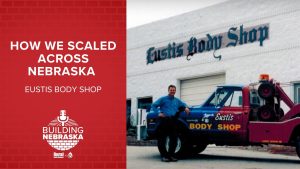
The company traces its roots back to 1979, when founder Doug Keller opened the original shop in Eustis. Clark said the community played a major role in getting the business off the ground.
“The community in Eustis really helped out,” Clark said. “They helped him put a new roof on and convert the building. He relied heavily on the community and has really poured back into it since.”
That connection to people has remained a core part of the company’s growth strategy.
“I would say the key to scaling the business is the culture,” Clark said. “Doug was very good about going to the locations and talking to people, asking about their families. It wasn’t just about numbers—it was about relationships.”
Today, that culture extends to employee ownership. Clark said about 25% of employees are shareholders in the company, helping drive long-term retention in an industry that often struggles with turnover.
“When the business does well, they do well,” he said. “They take pride in it.”
As the company has grown, so has the complexity of the work. Clark said modern vehicles have transformed the collision repair industry.
“It’s becoming more of a computer on wheels,” he said. “After a repair, those systems have to be relearned. You have to program modules, aim sensors, and make sure everything is working the way it’s supposed to.”
That shift has also contributed to rising repair costs, as advanced driver assistance systems and sensors add new layers to even routine fixes.
Despite those changes, Clark said the fundamentals of the business remain the same.
“It goes back to the roots,” he said. “It goes back to the community that started it all.”