



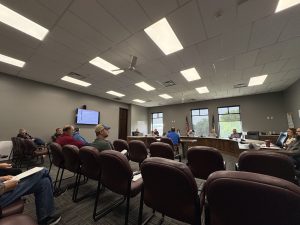
Members of the Custer County Planning Commission and the Custer County Board of Supervisors met Wednesday morning for a special joint meeting to hear from industry professionals regarding data centers and their impact in order to be equipped for informed decision making in the future.
The meeting focused heavily on questions surrounding electrical demand, water usage, noise, economic impact and infrastructure as county leaders continue evaluating how future data center development could affect communities in Custer County.
Speakers included Charlie White, a Land Agent with Aurum Capital Ventures, Jonathan Jank an Economic Development Consultant with Nebraska Public Power District, and Russ Callan with the Lower Loup Natural Resources District.
White focused on how public concerns stem from misinformation and misconceptions about the scale and operation of modern facilities. He stated that many misconceptions are linked to massive data centers for large companies that far exceed the capacity of those installed by his company.
“We’re doing 10-megawatt stations, five-megawatt data centers and things like that,” he said. “We are not chewing through millions of gallons of water a day.”
According to Charlie, only one of the company’s existing Iowa facilities currently uses water-based cooling. He said newer systems often operate with little or no water use and, in some cases, only require water during the hottest three to four months of the year.
He estimated the company’s “worst offender” uses roughly 10 gallons of water per minute, while some newer systems use between 250 and 300 gallons annually per megawatt.
Charlie said cooling systems use food-grade ethylene glycol and biodegradable descaling products, emphasizing the company’s effort to reduce environmental impacts.
“We’re trying to deploy the least offensive water users that we possibly can and the least offensive noise users as we possibly can,” he said.
Noise concerns were also addressed extensively during the meeting. Charlie acknowledged older air-cooled systems can sometimes be heard from several hundred feet away, particularly in quiet rural areas after crops are harvested. However, he said newer water-cooled systems are significantly quieter.
He described one facility where crickets were louder than the equipment at approximately 200 feet away and said newer facilities are designed to avoid disrupting nearby rural residents.
County officials asked about the economic footprint of proposed facilities, including job creation and tax revenue. Charlie said a typical 10-megawatt site requires approximately 1.5 to 2 acres and directly employs roughly four to five workers, though supporting roles such as electricians, mowing crews, snow removal contractors and local construction companies also benefit.
Power demand and utility infrastructure became one of the central themes of the meeting.
Charlie argued that data centers do not directly increase residential electricity prices because they are often designed to operate during off-peak hours when utilities have excess generating capacity available.
Representatives from Custer Public Power District and Nebraska Public Power District supported many of those explanations.
Jason of Custer Public Power District explained the utility system is built to handle heavy irrigation demand during the summer months, leaving substantial unused capacity during much of the year.
“Our system is basically being used about 25%” during portions of the year, Jason said. “If the data center was sitting there consuming energy, it would raise that load factor up and basically just kind of flatten out that curve.”
Jonathan Jank of Nebraska Public Power District provided an overview of the significant rise in requests for new electrical loads from a variety of industries, not just data centers. He said Nebraska’s comparatively low-cost electricity and existing infrastructure make the state attractive for development.
Water usage and groundwater protections were later addressed by Russ Callan of Lower Loup Natural Resources District, who outlined the permitting process for large water users in Nebraska.
Callan explained that the NRD requires permits for wells capable of producing more than 50 gallons per minute and requires hydrologic impact studies for projects consuming more than 500 acre-feet of water annually.
He said the water usage figures discussed during the meeting appeared to fall well below thresholds associated with major industrial facilities such as ethanol plants.
“We’re talking ethanol plant-size facilities,” Callan said. “The numbers that we’re throwing around here don’t even come close to that.”
Although he stressed the NRD is not advocating either for or against data center development, Callan said the agency’s role is to ensure groundwater resources remain sustainable.
No formal action was taken during the meeting, but county officials continued gathering information as they consider future regulations and potential development proposals involving data centers in Custer County.