



BROKEN BOW — Broken Bow officials are taking a cautious next step on proposed zoning rules for data centers and crypto-mining operations after public concern, and a recent inquiry from a data center operator shifted the urgency of the discussion.
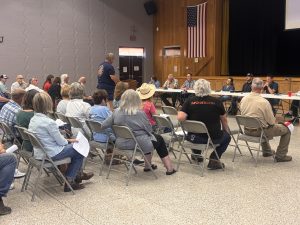
The Broken Bow Planning Commission reviewed a draft ordinance that would create strict local regulations for high-density data processing facilities, including data centers and digital asset mining operations. The proposal includes conditional use permit requirements, noise limits, water-use restrictions, residential setbacks, background checks, utility deposits, emergency power shutoff authority, and financial protections for future cleanup.
City officials said the goal is not to invite a data center into the community, but to make sure Broken Bow has rules in place before one can move forward.
“I completely understand the call to just outright ban data centers,” City Administrator Jake Holcomb said during the public hearing. However, he said municipalities have to work within state law and use zoning authority to protect themselves.
“When this was made, this topic did not even exist,” Holcomb said of the city’s current zoning ordinance. “This idea of data centers coming to small communities just wasn’t a thing that was accounted for.”
Holcomb also told the crowd that the issue had changed quickly after recent media coverage. He said that as of Thursday afternoon, no data center operator had contacted the city. After the topic became public, that changed.
“As soon as that information hit the media, we received communications from a data center operator inquiring about Broken Bow and the potential location,” Holcomb said. “We need to be in a position to protect our community, and our zoning authority gives us the best ability to get that done.”
Because of that, city officials are expected to recommend that the Broken Bow City Council consider a six-month moratorium on data center operations. Holcomb said the moratorium would give the city time to finish zoning regulations before any application could move forward.
The draft ordinance would classify any data center or digital asset mining operation with a connected electrical service capacity or peak power demand of 65 kilowatts or more as a high-density data processing facility. Those facilities would need a Conditional Use Permit before construction, installation, expansion, or operation.
Applicants would also have to submit a full site plan, building or container elevations, an electrical load analysis prepared by a Nebraska-licensed engineer, a pre-development noise impact study, cooling and ventilation specifications, a fire suppression plan approved by local fire authorities, and a decommissioning plan accepting sole operator liability.
The proposal also includes mandatory FBI fingerprint-based background checks for corporate officers, LLC members with at least 10 percent ownership, and on-site managers. Certain financial crime convictions within the past 15 years could disqualify an applicant.
Utility costs were a major part of the discussion. Under the draft, operators would be responsible for 100 percent of required municipal infrastructure upgrades, including substations, transformers, high-capacity wiring, transmission lines, water mains and wastewater modifications. The city would not subsidize infrastructure expansion for high-density data processing operations.
Operators would also have to maintain a three-month utility deposit or an irrevocable letter of credit based on estimated peak utility consumption. Holcomb said the city does not want local ratepayers left covering costs tied to a private facility.
“We don’t want to be on the hook for hundreds of thousands of dollars’ worth of power that we have bought and sold to this company,” he said.
Noise drew some of the strongest public concern. The ordinance would cap continuous sound at 55 dBA and 70 dBC when measured near residential structures, residential districts, public parks, churches or schools. It would also prohibit tonal, high-frequency, impulsive or repetitive mechanical noise from crossing property lines unless fully mitigated.
Facilities would be required to install engineered sound-dampening features such as sound walls, acoustic barriers or earthen berms. A noise study would be required before development, followed by a field-verified sound audit within 90 days of operation. The city could also require annual sound testing or additional testing after complaints.
If a facility violates noise limits, it could face immediate operational shutdown or utility disconnection until compliance is verified.
Water use is another major piece of the proposal. High-density facilities would have to use direct-to-chip liquid cooling, closed-loop liquid cooling, or an air-cooling system that consumes no municipal or groundwater during standard operations. Once-through cooling, open-loop systems, and systems requiring continuous freshwater consumption or wastewater discharge would be prohibited.
“The aquifer is extremely important,” Holcomb said. “This is our way of life. This is our lifeblood.”
Setbacks would be strict for dry-air cooled facilities using high-velocity fans, blowers or exterior HVAC units. Those facilities would have to be at least one-half mile from residential districts or existing homes, though that distance could be reduced through engineering and noise studies. It could not be reduced below 500 feet.
The draft also prohibits industrial-scale battery storage systems and on-site power generation used to power data processing, crypto mining, or mechanical cooling outside city-provided electric utilities.
Several residents and regional speakers urged the city to move slowly.
Trent Loos of Hazard said he has visited data centers and crypto-mining sites in multiple states and warned that utility demand is not a small issue.
“How do you increase an electric user in a community without increasing the cost to the end user?” Loos asked. “It’s impossible.”
Still, Loos praised the work already done by the city.
“This is the most thorough ordinance and proposed plan I’ve seen,” he said, adding that he supports a moratorium.
Mark Cardoza, who lives near Broken Bow on Sumner Road, also thanked officials for being proactive, but said he does not believe the area has the infrastructure to support that type of development.
“It’s not only the decibels that they’re finding that are hurting people,” Cardoza said. “It’s the frequency of that sound.”
Shailee Scranton of Thedford urged officials to consider a longer moratorium, saying large-scale data center developers often target rural areas that do not yet have regulations in place. She recommended requiring any applicant to hold at least one public meeting before a permit could be approved.
Jared Rasmussen of Broken Bow said rural residents should not be overlooked in the discussion.
“We also live in the country for a reason,” Rasmussen said. “I personally don’t want it.”
Jessica Owen, who lives north of town, asked officials to think beyond the permitting process and consider what would happen if utility problems affected homes, livestock operations, or people who rely on electricity for medical needs.
“I just want you guys to all think about the after,” Owen said. “If everything goes wrong, and we start saying, ‘Hey, we brought this up. We were worried about it. It’s happening.’ What are we all going to do about it?”
One Planning Commission member emphasized that the issue is not as simple as whether local officials personally want a data center in Broken Bow. The city must have legally defensible zoning rules in place, the member said, to avoid an outright ban that could expose the city to litigation.
“This is not a matter of whether we, as a board, want this or not,” the member said. “We have to have laws that would potentially allow any legitimate business to come in. The reason that we want to amend our zoning regulations is to restrict what can happen.”
After more than an hour of public comment, the Planning Commission voted to postpone consideration of the ordinance until a future meeting. Members said they wanted more time to review public input, possible additions to the ordinance, and the City Council’s expected discussion on a moratorium.
“We have more information that we need to process, given what you guys have told us,” one commission member said.
For now, Broken Bow’s proposed data center rules remain a draft. But the message from city officials and residents was clear: the community wants safeguards in place before any high-density data processing facility gets a foothold.