



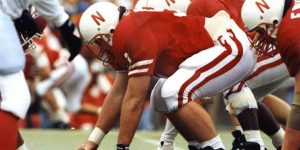
ANSLEY — Before Jim Scott became a first-team All-Big Eight center at Nebraska, a senior captain and now a Nebraska Football Hall of Fame selection, he was a kid in Ansley watching a successful high school football program set the standard.
Scott said growing up in Ansley made football feel natural. The community had strong teams, playoff appearances, and a tradition that younger players wanted to carry forward.
“Success breeds success,” Scott said. “When you’re having good seasons and good records, as a little kid and as you grow up through the ranks, you want to do what the ones before you did.”
Scott began his college career at Kearney State before transferring to Nebraska. Under the transfer rules at the time, he had to sit out a season, using that year to redshirt, learn the system, and develop. By the spring of his sophomore year, Scott said he started to feel like he could compete at the Division I level.
“If I just keep doing what I’m doing, I’m going to have a chance,” Scott recalled.
That chance turned into a major role on one of the most dominant rushing attacks in Nebraska history. Scott was part of the Husker offensive lines that helped Nebraska win back-to-back NCAA rushing titles and consecutive Big Eight championships in 1991 and 1992.
He said the secret was not complexity. It was repetition, execution, and physicality.
“We didn’t have a lot of different plays, maybe different formations, but still the same play,” Scott said. “We got good at what we knew we could do.”
The Huskers’ option attack also created problems for defenses. Scott said the triple option forced defenders into difficult decisions with angles, personnel, and assignments, often putting them on their heels.
In 1992, Scott helped lead the way for a Nebraska offense powered by running backs Calvin Jones and Derek Brown. Scott said the rotation between the two backs was unusual at the time, but it worked because both players brought high-level ability to the field.
“They both had exceptional careers,” Scott said. “They were very comparable in their running abilities and their strengths, and so it just worked out wonderful.”
As a senior, Scott was voted a team co-captain, an honor he said surprised him but showed the respect he had earned from his teammates. He was not the loud, fiery speechmaker type. Instead, he led through consistency.
“I was more of a lead by example, on and off the field,” Scott said.
Scott credited his development to coaches at both the high school and college levels. He said his Ansley coaches helped him build fundamentals, leverage, and footwork, while his Nebraska coaches continued to refine those skills.
He also placed a heavy emphasis on academics. Scott earned academic recognition during his Husker career and said his parents made sure he understood the value of earning a degree.
“That was the main goal of going to college, of course, was to get your education because you’re going to use it later in life,” Scott said.
Scott has done exactly that, spending his post-football career in banking.
When he looks back on his playing days, several games still stand out. One was Nebraska’s comeback win over Oklahoma during his junior season, a game the Huskers needed to capture the Big Eight championship. Scott also pointed to Nebraska’s 52-7 win over Colorado on Halloween night in 1992 and a strong performance against a highly regarded Kansas team the following week.
For small-town athletes hoping to follow a similar path, Scott said the formula remains simple but demanding: work in the classroom, work in the weight room, and work on the field. He said athletes should also understand that college football opportunities exist at many levels, not just Division I.
“There’s a lot of good levels of football still being played out there,” Scott said. “If there’s an opportunity there and you want to play, you’ve got to dedicate yourself, and you’ve got to work at it.”
Now, the Ansley native’s football journey will be permanently recognized with his selection to the Nebraska Football Hall of Fame, which is a fitting honor for a player who helped anchor one of the most physical and productive eras of Husker football.
You can listen to the full interview with Jim here: