



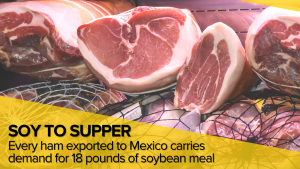
The next time you sit down for a pork chop or ham sandwich, that product may represent more than just a meal. It could also represent demand for Nebraska soybeans and corn.
The U.S. Meat Export Federation (USMEF) says growing global demand for U.S. pork, beef and lamb is creating new opportunities for producers across the entire agriculture supply chain.
John Hinners, senior vice president of industry relations, says the partnership between livestock groups and soybean producers helps create value beyond the farm gate.
“When you have a strong livestock industry, it just provides another avenue for those soybeans and corn crops that we’ve been so good at producing here in the United States and more specifically in the state of Nebraska.”
Hinners says expanding soybean crush capacity in the U.S. will create more soybean meal, and one way to add value is by feeding it to livestock and exporting the finished product.
“Every time you send a ham outside the United States, and if it crosses into Mexico, that’s 18 pounds of soybean meal and an additional one and a half bushels of corn that are just utilized in producing that ham.”
Mexico remains the top market for U.S. hams, with the U.S. exporting roughly half of its hams. But Hinners says diversification is critical, pointing to markets like Japan, South Korea and Colombia as important destinations for U.S. pork cuts.
The goal, he says, is finding markets around the world that value different products, including cuts that may not be as popular with American consumers.
USMEF is also focused on understanding consumer preferences around the world. Hinners points to a product called Nutra Liver, developed with meat scientists at the University of Nebraska-Lincoln, as an example of matching U.S. production with global nutrition needs.
The product uses beef liver, a cut with limited demand in the U.S., but one that is valued in markets like Peru and Colombia.
Key takeaways:
- Exports connect livestock and row crops: Strong demand for U.S. meat supports demand for Nebraska soybeans and corn used in livestock feed.
- Mexico is the top market for U.S. hams: The U.S. exports about half of its hams, with Mexico a major buyer.
- A single exported ham represents agricultural demand: Each ham sent to Mexico uses about 18 pounds of soybean meal and 1.5 bushels of corn in production.
- Japan remains a key pork market: U.S. pork loin exports have grown from about 10% in 2019 to roughly 20% today.
- Finding new uses for products adds value: Export markets can create demand for cuts that are less popular among U.S. consumers.
- Global consumers have different preferences: Products like Nutra Liver aim to address nutrition needs while creating new markets for U.S. beef.