


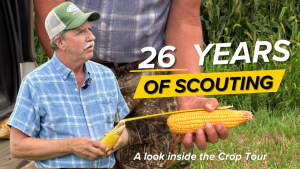
For 26 years, Tim Gregerson of Herman, Nebraska, has spent part of his summer traveling the Corn Belt as a scout on the Pro Farmer Crop Tour.
While the tour’s annual yield estimates often draw attention from the agriculture industry and markets, Gregerson’s experience offers a look at what happens before those numbers are released.
Gregerson, who farms corn and soybeans near Herman, first became interested in the tour because of his background in agronomy. He wanted to see how crops were developing outside his own area and bring new ideas and observations back to his farm.
“You can get so busy at home and learn about things just in your area, but I wanted to open a new world to ideas of what I could maybe bring back home to my farm to help it be more successful,” Gregerson said.
Gregerson describes the Pro Farmer Crop Tour in two words: “Randomly consistent.”
Scouts travel established routes each year, with samples taken randomly from fields along those routes. The goal is to create a consistent way of measuring crops from year to year while limiting human selection or bias in where samples are taken.
“We want to take and make the whole corn belt, one cornfield and one bean field from Ohio to Nebraska,” Gregerson said.
In the field, scouts move past the end rows before measuring a designated area. For corn, Gregerson said scouts take 35 paces into the field before measuring 30 feet of two rows and counting the ears.
From there, specific ears are selected for additional measurements.
“We take the fifth, eighth, and eleventh ear, always that fifth, eighth and eleventh,” Gregerson said.
Those ears are brought back to the vehicle, where scouts count the rows around each ear and measure the length of the harvestable grain from the butt to the tip. The measurements are then entered into a formula to produce a rough yield estimate.
The process gives scouts a standardized way to collect observations across a large geographic area.
Gregerson said the information gathered in the field is sent back to Pro Farmer’s home base, where the data is compiled. Scouts then meet in the evenings to review the information before the results are released.
Soybean sampling follows a different process, and Gregerson noted that the timing of the tour means it is too early to determine a soybean yield. Instead, the tour provides a snapshot of soybean development that can be used to track the crop’s progress from year to year.
For Gregerson, the value of participating goes beyond the numbers released at the end of the tour.
He said the tour began as a way to give farmers another source of information about factors outside their control, including government policy, USDA decisions and the commodity markets.
“We’re just trying to get a synopsis year after year after year and give an honest, another option for farmers to use in their marketing,” Gregerson said.
After 26 years, the experience also continues to give Gregerson a chance to see crops and farming conditions beyond his own fields near Herman.
He said traveling outside his immediate area has helped him learn about different conditions and ideas that he can bring back to his own operation.
The Pro Farmer Crop Tour covers fields from Ohio to Nebraska during its annual trip, with scouts collecting thousands of observations along the way.
For Gregerson, it remains an opportunity to step outside his own farm, see what is happening across the Corn Belt and bring that perspective home.