



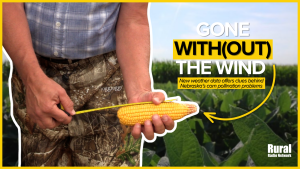
Pro Farmer Crop Tour scouts found Nebraska’s lowest corn ear count since 2013 and pointed to heat stress and pollination problems as key concerns. Now, Nebraska Extension climatologist Eric Hunt says weather data from July helps put those observations into context.
Hunt says conditions varied across the state as corn went through pollination, with some areas entering that critical stage with adequate moisture while dryland fields farther west were already running short.
But moisture wasn’t the only concern.
Quick Read
- Warm nights may have hurt pollination, with unusually high nighttime temperatures during the second half of July.
- Unusually calm winds could have affected pollen movement, adding another potential factor behind low ear counts.
- Recent rains have improved soil moisture, giving some Nebraska crops a better chance to finish.
Much of Nebraska experienced a stretch of unusually warm nights during the second half of July, when much of the state’s corn crop was pollinating. Hunt says the nighttime heat likely added stress to the crop, even though daytime temperatures generally weren’t high enough to outright kill pollen.
“We did have a lot of very warm nights here for quite a while in the back half of July for pretty much everybody. So that probably, I think was detrimental,” Hunt says.
GONE WITH(OUT) THE WIND?
Hunt also looked at another piece of weather data that could help explain some of the pollination issues reported by Pro Farmer scouts: wind.
He says July was unusually calm across eastern Nebraska and much of the western and central Corn Belt. That’s notable because corn relies on wind to move pollen from the tassels to the silks.
“It was unusually calm across at least the eastern half of Nebraska and most of the western central Corn Belt,” Hunt says. “We were really hitting that in the month of July. So that may have helped or may have hurt some of that pollen, actually getting truly into the silks.”
Hunt cautions that he’s not a plant physiologist, so the weather data doesn’t prove that light winds caused pollination problems. But it does provide another piece of evidence for understanding what scouts found in Nebraska fields.
Pro Farmer estimated Nebraska’s corn yield at 163.61 bushels per acre, down nearly 9% from its estimate last year and 5.6% below the three-year average. Scouts also reported significant tip-back in dryland corn, particularly in northeast Nebraska, along with declining grain length.
NEBRASKA MOISTURE OUTLOOK IMPROVES
While the weather during pollination may have limited some of this year’s corn potential, Hunt says Nebraska’s moisture situation has improved substantially in recent weeks.
The latest U.S. Drought Monitor shows 87% of the state in some level of drought, down from nearly 92% a week earlier and more than 95% three months ago. The share of Nebraska in severe drought or worse has also fallen from 18.5% a week ago to about 12.8%.
Hunt says parts of eastern Nebraska now have a full soil-moisture profile, while central and northeastern Nebraska have seen meaningful improvement in the upper portions of the soil profile.
That late-season moisture could help crops finish, even if it can’t undo stress that occurred during pollination.
Hunt says some Nebraska producers may no longer need to irrigate for the remainder of the growing season, depending on location and future rainfall.
The weather pattern is expected to turn warmer toward the end of the week, with temperatures potentially reaching the upper 80s to mid-90s across parts of the state.