


For farmers looking for ways to improve soil health while maintaining crop productivity, Govier Farms near Broken Bow is putting several practices to work in their fields.
From reduced tillage and cover crops to alternative fertilizer products and livestock integration, Clay Govier says the goal is to build healthier soils and more resilient crops.
“I think having healthy soils leads to healthy soils leads to healthy crops, which just adds to the resiliency that our crops have to fight through over the course of a year because of the crazy weather,” Govier said.
Govier Farms uses a combination of management practices, including diverse crop rotations, cereal rye, reduced tillage and split fertilizer applications.
Govier says they use split applications to help reduce the amount of nitrogen applied while limiting the potential for nutrient loss.
The farm also uses products such as compost, compost extract and ocean minerals to supplement soil fertility. Cereal rye is another part of the rotation. When it comes to harvest time some of the rye is used for grain, selling to local farmers for cover cropping needs and sold for rye whisky at Kinkaider Brewing based out of Broken Bow.
Govier noted that cover crops aren’t a one size fits all practice. Farmers need to consider moisture, timing and potential pest pressure when deciding how to manage them.
One practice Govier Farms is testing is a skipped row approach with cereal rye. A row is left open in the cover crop so corn can be planted into that space the following year.
The strategy allows the corn to have less competition while still receiving benefits from the cover crops between rows, including erosion control, nutrient cycling and weed suppression.
“A little corn doesn’t like a lot of competition, but then, so basically you’re eliminating the competition in the row for the corn, but then you’re still able to realize the cover crop benefit in between the rows.”
The cover crop can also provide protection for young corn plants during windy conditions.
For producers considering cover crops or other soil health practices, there are programs available to help reduce some of the financial risk. Some of the programs mentioned were through the Natural Resources Conservation Service (NRCS), Natural Resources Districts (NRD) and Practical Farmers of Iowa (PFI).
Josiah Pollock with Practical Farmers of Iowa says the organization offers cost share opportunities for farmer planting cover crops in 2026.
The 2026 cost share program with cover crops is currently open with sign up opportunities available at practicalfarmers.org. The organization offers several programs for farmers including a nitrogen reduction rate program. Pollock says farmers who reduce their nitrogen rate on corn and experience a yield loss can receive $30 per acre through the program.
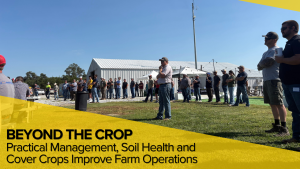
Practical Farmers of Iowa also hosts field days across the Midwest, giving producers an opportunity to see management practices firsthand and learn from other farmers.
Back at Govier Farms, cattle are another piece of the system. When livestock are turned onto corn residue, Govier said they notice the cattle will typically eat the greener cover crop first before moving on to the corn residue and ears.
For farmers considering changes to their own operation, Govier says soil health practices require management and observation, but the goal is to build a system that can better withstand changing conditions one step at a time.