


Funding for this series is made possible by the Specialty Crop Block Grant Program, a USDA-funded initiative supporting specialty crop producers.
Growing specialty crops on a small scale takes more than a green thumb.
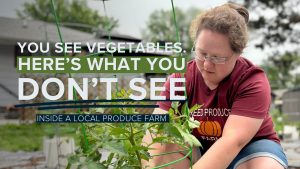
For Jenny Freed of Freed Produce Farms in Holdrege, producing vegetables, pumpkins, squash and ornamental corn involves horticulture, entomology, irrigation, pest management and plenty of daily decision-making.
Freed grows about two acres of specialty crops, with some production at her property in the Holdrege city limits and the rest on her parents’ farm north of Loomis.
Her operation includes sweet corn, tomatoes, peppers, cucumbers and green beans during the summer, followed by pumpkins, squash and ornamental corn in the fall. She also raises chickens and ducks, sells eggs, produces jams and jellies and grows houseplants.
But the management behind those crops is what sets specialty crop production apart.
LEVERAGING… THE BUGS?
Freed has a master’s degree focused on plant-insect interactions and uses that background in the field. Rather than viewing every insect as a pest, she looks at how plants and insects interact and works to maintain a balance between beneficial insects, pollinators and insects that can damage crops.
At her Holdrege location, Freed uses intercropping, growing different crops alongside one another, and incorporates flowers into her production to attract pollinators and beneficial insects.
“So I do a lot of intercropping with we’ve got the vegetable crops, but then I also grow a lot of flowers that brings in the good pollinators and try to have a balance,” Freed said.
That approach also carries into pest management.
Freed said cucumber beetles have been one of the challenges she has encountered, but she has used minor applications of the biological pesticide Bt when necessary.
Freed also uses drip irrigation as part of her production system, delivering water directly to the crops. The system connects to her phone, allowing her to control when and how much water the crops receive, even when she’s away from the farm.
‘CHAOS AND TRIAGE’
For a one-person operation with some additional help, keeping everything moving can be one of the biggest challenges.
Freed describes the day-to-day management as “chaotic,” with decisions constantly being made about what needs attention first — from planting and watering to weeding and harvesting.
“It is just trying to be as efficient as possible in each thing…. I’m going to say it’s a lot of triage,” she laughed.
Freed’s path into specialty crops began with her family farm background and an interest in plants that started with an African violet as a child. She eventually bought an African violet business at age 14.
Years later, during the uncertainty of the COVID-19 pandemic, she decided to put her horticulture and entomology background to work on a larger scale. After initially planting pumpkins without a clear market, she began expanding into other produce and has continued growing the operation each year.
Marketing remains another challenge for a small specialty crop producer. Freed initially attracted customers by putting a sign along the highway pointing toward her home. She now uses social media, word of mouth, local food directories, a website and other outlets to reach customers.
For Freed, the goal goes beyond simply growing food.
“This is a local operation and I really appreciate anybody’s support coming out here,” she said. “We’re producing a fresh product… and we’re trying to grow responsibly here.”