


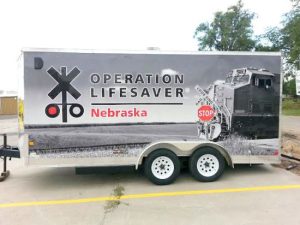
As Nebraska’s harvest season continues, Operation Lifesaver is reminding farmers and agricultural workers to use extra caution when crossing railroad tracks with combines, tractors, grain carts, and trucks.
Deb Ashworth, state coordinator for Operation Lifesaver Nebraska, says railroad crossing safety is especially important during harvest when more large equipment is on rural roads. Ashworth noted that a person or vehicle is struck by a train every three hours somewhere in the United States.
“Tragically every three hours a person or vehicle is hit by a train in the United States,” Ashworth said. “That is a sobering statistic for anyone involved in teaching rail safety or anyone that works for the railroad.”
Ashworth said many people underestimate both the speed of trains and the distance required for them to stop. She noted that trains can operate on any track at any time and from either direction.
“Trains are so much quieter than you would think and a person may not hear them until it’s too late,” Ashworth said. “Trains take a mile or longer to stop, and they are traveling much faster than what it may appear when you’re looking at them.”
Operation Lifesaver recommends producers inspect hitch pins before crossing tracks, secure all loads, and ensure equipment is properly aligned with railroad crossings. Ashworth also warned that top-heavy grain wagons and liquid loads can be prone to tipping.
She advised motorists to slow down when approaching crossings, open cab windows, turn off radios and fans, and remove other distractions to better hear and see approaching trains.
“If you see tracks, think trains,” Ashworth said. “Know the facts, make good decisions, slow down as you approach a railroad crossing, be prepared to stop, and look and listen for a train.”
Ashworth also reminded operators that trains always have the right-of-way and that equipment should remain at least 15 feet from railroad tracks. If equipment becomes stuck on the tracks, operators should exit immediately and use the emergency contact information posted at the crossing to notify the railroad.
Additional railroad safety information and educational resources are available through Operation Lifesaver at oli.org.