



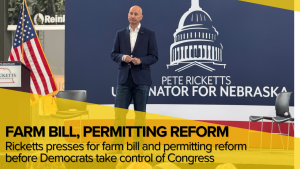
Nebraska senator says farmers need certainty from a five-year farm bill, while streamlined permitting could help expand domestic fertilizer and energy production.
Nebraska U.S. Senator Pete Ricketts says Republicans are working to advance several priorities before Democrats take control of Congress in January, including a new farm bill and bipartisan permitting reform.
In an interview with Rural Radio Network, Ricketts said Republicans have around 50 days to move their agenda before losing their majority. Among his priorities is completing a five-year farm bill, which he says would give farmers and ranchers much-needed certainty.
The farm bill has been negotiated on a bipartisan basis, but negotiations remain stalled over proposed changes to the Supplemental Nutrition Assistance Program, or SNAP.
Ricketts said Democrats want to delay implementation of the new SNAP requirements for two years, while Republicans have offered a one-year delay. He said resolving that disagreement could clear the way for the legislation to advance.
“Farmers and ranchers deserve the certainty of a five-year farm bill,” Ricketts said.
The legislation also includes year-round access to E15 gasoline, an issue Ricketts has championed as a way to support corn demand while potentially saving consumers money at the pump. It also includes provisions Ricketts supports to restrict Chinese purchases of U.S. farmland.
Ricketts warned that failing to pass the bill this year could mean further delays, particularly because some existing farm bill authorities have expired. He said the legislation has already been negotiated between Republicans and Democrats and urged lawmakers to resolve the remaining SNAP dispute.
Permitting reform could affect fertilizer costs
Ricketts is also working on bipartisan legislation to streamline federal permitting for infrastructure, energy and manufacturing projects.
He said lengthy regulatory and approval processes can hold up investment and drive up costs. For agriculture, one potential benefit is making it easier to build new domestic fertilizer production capacity.
Ricketts pointed to a proposed fertilizer plant in central Nebraska, saying the sooner it can be built, the sooner farmers could potentially benefit from additional domestic supply.
He also argued that expanding energy production and refining capacity could help lower energy costs and reduce the country’s reliance on events in other parts of the world.
The permitting legislation has advanced through the Senate Environment and Public Works Committee, where Ricketts said it received large bipartisan majorities in two rounds of voting.
Democrats set to shape the next Congress
The interview comes as Democrats prepare to take control of both chambers of Congress in January, giving them leadership of key committees, including the House and Senate agriculture committees.
Ricketts said the change will bring a different set of legislative priorities. He argued that Republicans should use the remaining weeks of their majority to advance as much of their agenda as possible.
At the same time, he said he sees opportunities for continued bipartisan work, including on permitting reform, foreign policy and export controls.
Ricketts also suggested the focus on affordability could provide common ground. He said both parties have an interest in addressing the cost of living, including energy and other expenses facing American households.
“Both Republicans and Democrats want to bring the cost of living down for Americans,” Ricketts said.
Ricketts said he plans to continue working on biofuels and permitting reform in the next Congress, even as Democrats take control of committee leadership. He also said he intends to work with Democratic colleagues on areas where the two parties can find agreement.