


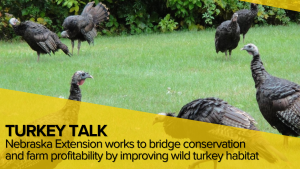
As Nebraska farmers look for ways to make every acre pay, a University of Nebraska-Lincoln researcher says some of the ground that produces the least in the combine could provide another kind of value — for both the producer and wildlife.
Andrew Little, with the university’s Applied Wildlife Ecology and Spatial Movement Lab, says conservation and profitability do not have to compete.
“Ultimately, we’re taking areas where maybe marginal acres … you’re driving through, you notice those areas on your yield monitor that are just not producing as well as other portions of your field,” Little said.
Those acres could be put to alternative uses, including wildlife habitat or targeted cover crops, potentially reducing input costs while improving the overall profitability of a farm.
The idea is to evaluate land on a per-acre basis, accounting for expenses such as diesel and other production costs, and determine how each part of a field can work best for the producer.
“We want to be able to find ways we can actually maximize every acre’s profitability,” Little said.
That approach could also help address a broader challenge for wildlife across Nebraska and the nation.
Little said habitat has generally declined since the 1960s, as agricultural mechanization and other changes have helped farmers maximize production. Smaller fields and more diverse habitat once provided more places for wildlife such as quail, pheasants and wild turkeys.
Urbanization has also contributed to habitat loss.
The consequences can be difficult to recognize from one farm or one community. Little said he has heard landowners describe very different experiences with wild turkey populations, depending on where they live.
A project with the Nebraska Game and Parks Commission found that Nebraska’s wild turkey population declined about 45% from 2009 through the early 2020s, Little said.
He cautioned that wildlife populations are influenced by many factors, describing the declines as “a death by a thousand cuts.” But habitat remains a key part of the equation.
“If there’s not enough habitat available out there, they’re forced to move somewhere else,” Little said. “And if there’s no other places out there, ultimately population is not going to likely see substantial increases without basically having available homes, per se, out there for them to live in.”
One option for producers is the Conservation Reserve Program, which can help target environmentally sensitive or marginal acres for conservation. Little said habitat can be placed strategically in areas where producers are dealing with concerns such as erosion.
The lab is also studying what it calls “stackable enterprises” — additional sources of income that could help farmers and ranchers make conservation more financially viable.
The goal is to give producers more flexibility to put less productive acres into conservation while maintaining the long-term sustainability of their operations.
“It’s got to work for the farmers and ranchers out there from a profitability side,” Little said. “It’s got to help them ensure the long-term sustainability of their operations.”
For Little, that is the connection between working lands and wildlife habitat: conservation is more likely to succeed when it makes economic sense for the people who manage the land.
The Applied Wildlife Ecology and Spatial Movement Lab is part of the University of Nebraska-Lincoln. More information is available by searching for the AWESM Lab online.